
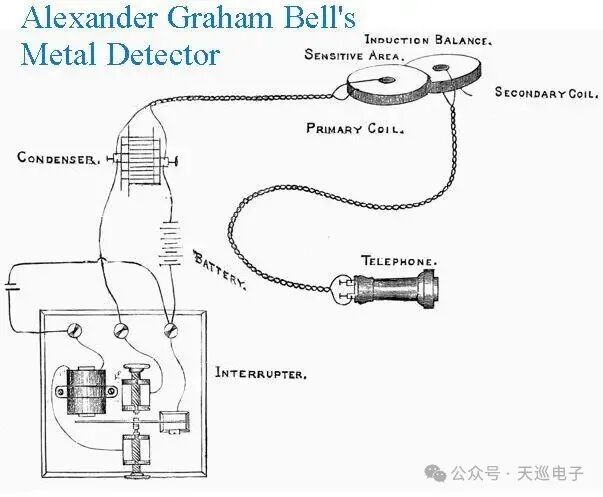
Metal detectors mainly use the principle of electromagnetic induction to detect metal objects. Its core components include transmitting coil, receiving coil and signal processing circuit.
1、The working process is as follows:
Emitting electromagnetic field: When the transmitting coil is energized, it generates an alternating magnetic field to cover the detection area.
Metal object interference: When a metal object enters the magnetic field, it will generate eddy currents due to electromagnetic induction, and then generate a secondary magnetic field to interfere with the original magnetic field.
Signal detection: The receiving coil detects the change in the magnetic field and generates an electrical signal, which is converted into sound, light or digital display after amplification and processing to indicate that metal has been detected.
Signal processing: Modern metal detectors use digital signal processing (DSP) and artificial intelligence technology to enhance detection accuracy and can distinguish metal types, depth and other information.

Different types of metal detectors (such as VLF, PI, BFO) differ in frequency, sensitivity and application scenarios. For example, **Very Low Frequency (VLF)** detectors are suitable for distinguishing metal types and are widely used in security inspections and treasure hunting; **Pulse Induction (PI)** detectors are suitable for deep detection and are often used in mineral exploration.
2, Historical development of metal detectors
The history of metal detectors can be traced back to the 19th century, and the development process is as follows:
19th century: The principle of electromagnetic induction was proposed by Michael Faraday, laying the theoretical foundation for metal detectors.
1881: Alexander Graham Bell tried to use early metal detection equipment to find the bullet in the body of US President Garfield. Although he failed, he promoted the development of technology.
Early 20th century: Early metal detectors were used in the military, such as detecting mines during World War I, but the equipment was bulky and had low sensitivity.
1930s: German engineer Gerhard Fischer invented a portable metal detector and obtained a patent in 1931, marking the beginning of modern metal detectors.
During World War II: Metal detectors were widely used in the military field to detect mines and unexploded bombs, and the technology gradually matured.
1950s-1970s: With the advancement of electronic technology, metal detectors became lighter and more sensitive, and the introduction of induced polarization and airborne electromagnetic methods promoted the development of mineral exploration.
1980s to present: With the rise of digital and intelligent technologies, metal detectors began to integrate computer processing and artificial intelligence to achieve automated data analysis and target classification. The application areas have expanded to security inspection, archaeology, industrial inspection, etc. At present, metal detector technology has developed to the digital and intelligent stage, the detection efficiency and accuracy have been significantly improved, the market scale has continued to expand, and more and more treasure hunting enthusiasts have joined in.
3, Shanghai Tianxun's global production ranking
Shanghai Tianxun Electronic Equipment Co., Ltd. (Tianxun) is a well-known metal detector brand in China, focusing on the research and development and production of security inspection equipment and underground metal detectors. According to industry data and market research: Domestic market: Tianxun ranks among the top domestic metal detector brands, known for its high cost performance and good user reviews, especially in the fields of security inspection and treasure hunting. In the 2024 industry report, Tianxun is listed as one of the well-known domestic brands. Global ranking: The global metal detector market is mainly dominated by international brands such as Australia’s MINELAB, the United States’ Garrett, France’s XP, and China is currently dominated by Tianxun. In the 2024 Top Ten Metal Detector Brands Ranking, international brands such as MINELAB and Garrett are at the forefront, while TIANXUN as a Chinese brand, ranks in the middle. Its specific ranking is not among the top five in the world, but it ranks first in the Chinese market.
Market performance: TIANXUN’s products have a high market share in the outdoor treasure hunting market, and its influence in the international market is mainly due to the development of e-commerce platforms, such as Amazon, AliExpress, TEMU, OZO and other mainstream e-commerce platforms, mainly concentrated in the United States, Europe, Russia, South America and other countries.
Due to the lack of public information on specific global production data, TIANXUN’s precise ranking is difficult to determine, but its performance in the domestic market and some international markets shows that it is a second-tier brand and is improving its competitiveness through technological innovation. TIANXUN will continue to be committed to the research and development and production of metal detectors.


